

Last updated: 2026-11-20
The European Commission has formally published its guidance on the application of the Cyber Resilience Act (CRA): as Communication C/2026/6013 in the Official Journal of the European Union of 17 November 2026, which also makes it available in German. The Commission had already presented the guidance on 27 July 2026. For manufacturers, it is an extensive interpretation aid on questions that come up frequently in projects: when software is a product under the CRA, when a back end is part of the product, what applies to products designed before the Regulation applies on 11 December 2027, and when an update turns a product into a new one.
One point matters for reading it: the guidance is not binding. Only the Court of Justice of the European Union can give an authoritative interpretation of the CRA (para. 8). It does show how the Commission reads the Regulation and, by its own account, is also intended to support the work of market surveillance authorities and notified bodies (para. 6). We expect them to take it into account, but they are not bound by it. The examples in the guidance do not replace a case-by-case assessment (para. 8). A public consultation ran from 3 March to 13 April 2026 before publication (para. 7).
What already applies today: the reporting obligations
Most obligations apply from 11 December 2027. The reporting obligations under Article 14, however, have applied since 11 September 2026 (Article 69(3)). Manufacturers must report actively exploited vulnerabilities and severe incidents, also for products placed on the market before 11 December 2027 and also where a product is no longer supported (para. 210). Anyone who does not yet have a reporting process should address that first.
Software: when it counts as placed on the market
Standalone software is placed on the market once its manufacturing phase is complete and it is first supplied for distribution or use on the Union market in the course of a commercial activity (para. 14). All copies of the same version are considered placed on the market at the same time, regardless of when a customer downloads them (paras 13 and 14, example 1).
Two consequences matter for planning:
- For placing on the market, variants are separate products. Versions that differ in components, configuration or enabled functionality, such as builds for different operating systems or bundles with different feature sets, are not copies of the same product (para. 14).
- Updates only move the date if they are substantial modifications. A new version without a substantial modification needs no new conformity assessment and does not change the date of placing on the market (para. 15, example 2).
Installed or browser-only: what belongs to the product
The guidance draws a clear line between software that runs on the user's side and software the user merely accesses. Software that is downloaded, installed or otherwise supplied and executes on the user's system can fall within scope if it is placed on the market in the course of a commercial activity, including a browser extension or an application built with web technologies but run locally (paras 20 and 21, examples 3 and 4). A web application used exclusively through a browser is, as a rule, not on that basis alone a product with digital elements, nor is a website that only provides information (para. 21, examples 5 and 6). Both can still form part of a product as remote data processing if they support a function of a product and the further conditions are met (see below).
Whether software belongs to a device depends on whether the device needs it to perform its intended functions. The channel through which it reaches the user does not matter for this (para. 25). Printer drivers downloaded from a website and the manufacturer-provided companion app a fitness tracker requires, obtained from an app store, form a single product with the device (examples 8 and 9). A manufacturer that licenses source code to customers places that code on the market, even if the customer still adapts and compiles it (para. 24, example 7). Unfinished code shared during the design and development phase, for example for testing, and sample or demo code in training material, by contrast, are not considered placed on the market (para. 23). Unfinished software made publicly available for testing for a limited period is additionally subject to Article 4(3): it must be visibly marked as not compliant.
More on scoping for software providers is in our article CRA for software and SaaS, and on interfaces in data connection and interfaces.
Remote data processing: when the back end is part of the product
The CRA covers data processing at a distance where it is needed for the product. The guidance turns this into two cumulative questions (paras 188 and 202):
- Would the absence of the processing prevent the product from performing one of its functions? This also covers functions beyond the core. The guidance names sending commands to a device, synchronising files, onboarding users, configuration, automated distribution of updates, and identity and access management (paras 189 and 190). Telemetry analysed purely for statistics or future product development is not included (para. 192).
- Was the software designed and developed by the manufacturer or under its responsibility? This covers in-house development and solutions a service provider builds for the manufacturer on the basis of the manufacturer's designs and specifications, but not licensed off-the-shelf products (para. 195). Who operates the solution is not decisive (para. 196). Processing on the manufacturer's own servers or in a private cloud can also be remote data processing (para. 187).
For cloud models this means: the manufacturer's own software on third-party IaaS or PaaS can form part of the product's remote data processing, a ready-made third-party SaaS application cannot (paras 198 to 200). Where its integration affects the product's security, it should be treated like a component: assess the risks of integrating it, address them at product level and exercise due diligence (paras 201 and 202). Back-end systems the product does not interact with directly are not remote data processing but remain external dependencies in the risk assessment (paras 205 and 206). The technical documentation should state which remote data processing the product has or which third-party solutions it relies on (para. 204). Evidence for third-party services can include, among other things, proof under NIS2 Implementing Regulation (EU) 2024/2690, under DORA or certificates under the Cybersecurity Act (para. 207).
Products designed before the Regulation applies (11 December 2027)
Many manufacturers will place on the market, from 11 December 2027, units of a model designed long before. The guidance makes clear that this does not automatically require a redesign (paras 33 and 34). What counts is the cybersecurity risk assessment: if it shows that the product already has appropriate and effective security measures, the manufacturer may rely on them (paras 34 and 36).
Where it is no longer possible to show how risks were considered during the original design, the guidance accepts a current risk assessment and technical documentation with which the manufacturer can demonstrate that the existing design mitigates the risks appropriately. For conformity assessment under Article 32(1), test results from the original design and development phase do not have to be provided if the risk assessment shows appropriate and effective security measures. Tests that are still needed can be grouped for products with the same design and risk profile (paras 35, 36 and 38, example 12). The other obligations remain: conformity assessment, EU declaration of conformity and CE marking (para. 35), vulnerability handling under Annex I Part II and a risk assessment kept up to date (para. 39).
Units already placed on the market before 11 December 2027 are a different matter. The CRA requirements apply to them only if they are substantially modified afterwards (Article 69(2)). The reporting obligations apply to them nonetheless.
When an update is a substantial modification
For software manufacturers this section is particularly relevant in practice. Legally, a substantial modification is a change after placing on the market that affects compliance with the essential requirements in Annex I Part I or modifies the intended purpose (Article 3(30) CRA). For software updates, the guidance explains what matters: whether the update brings new or increased cybersecurity risks that the risk assessment has not yet taken into account (para. 104). What counts is the effect on the risk profile. The scope or complexity of the change is not the yardstick (para. 107).
- New intended purpose: a change of intended purpose generally counts as a substantial modification. Example: a dashboard that only displays machine data and later gains the ability to control machines (para. 105, example 40).
- Small feature, new risk: even a "remember me" feature that stores authentication tokens locally can be a substantial modification if the risk was not assessed (example 44).
- Assessed in advance: features whose risks the manufacturer already described, assessed and mitigated in the original assessment, and which it implements as assessed, such as planned group chat or control functions enabled later, are, as a rule, not substantial modifications (para. 106, examples 42 and 43).
- Security updates: as a rule they are not substantial modifications, even where they make deep technical changes (para. 108, examples 46 to 48). It can be different if a security update changes the intended purpose or introduces new dependencies, data flows or externally reachable interfaces, such as a third-party external key management service (para. 109, examples 49 and 50).
For the case-by-case assessment the guidance names four criteria manufacturers can, for example, take into account (para. 110):
| Criterion | Examples |
|---|---|
| New threat vectors? | Additional interfaces, communication channels, execution environments or external dependencies |
| New attack scenarios? | New ways of unauthorised access, manipulation, interference or misuse of the product or its data |
| Changed likelihood of previously identified attack scenarios? | Less effort for attackers, more exposure to untrusted actors, weakened safeguards |
| Changed impact of previously identified attack scenarios? | More data or functions affected, more severe consequences, weaker detection or recovery |
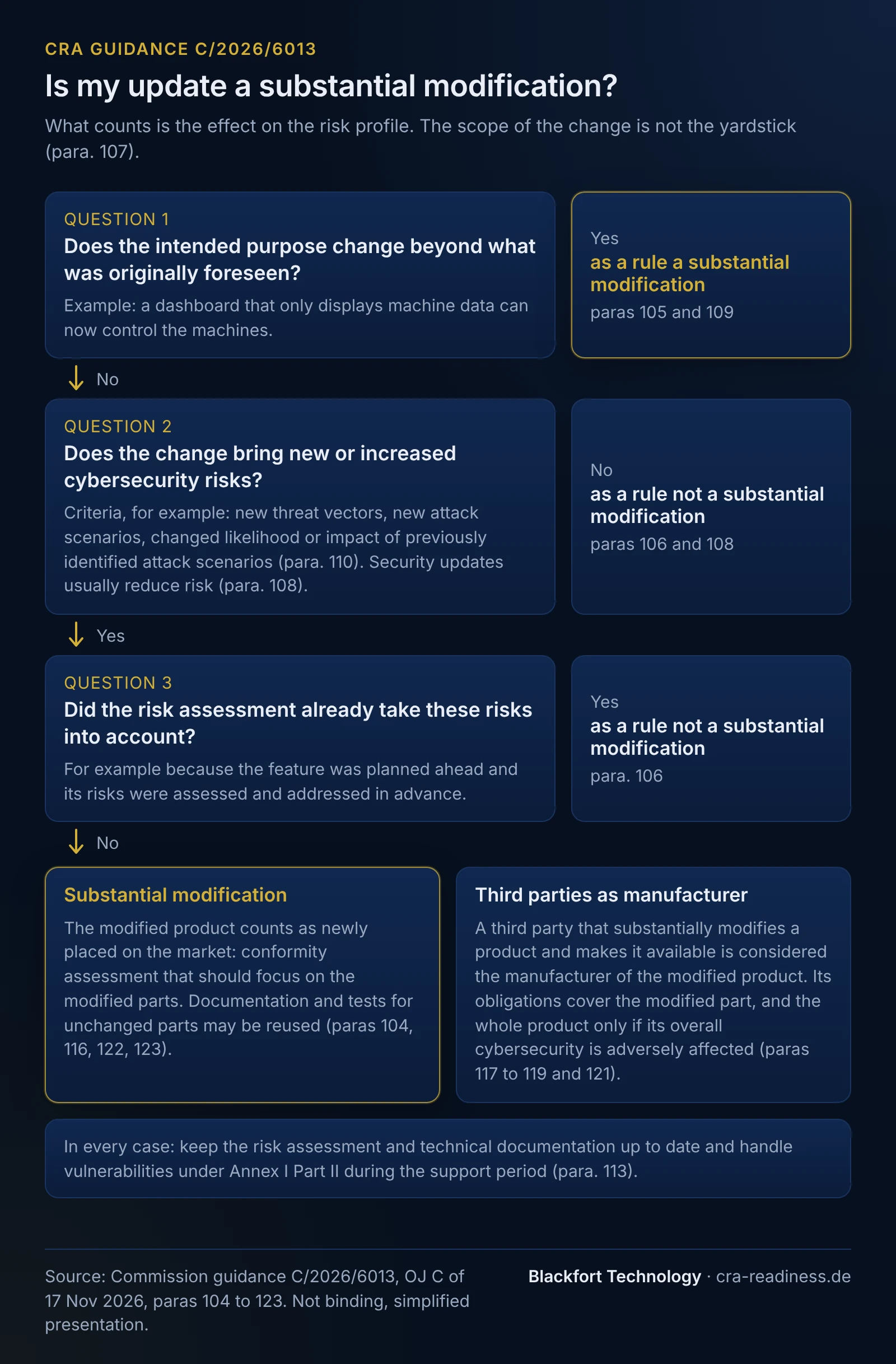
If a modification is substantial, the modified product is considered newly placed on the market when it is made available (paras 116 and 122). The manufacturer may reuse documentation and tests for parts not affected by the modification (para. 123). A third party that substantially modifies a product and makes it available is considered the manufacturer of the modified product (para. 117). Its obligations are then limited to the modified part, as long as the modification does not adversely affect the cybersecurity of the product as a whole. Otherwise the modified product is to be treated as a new product in its entirety (paras 118, 119 and 121). Regardless of the classification, the risk assessment and technical documentation must always be kept up to date (para. 113). If the original manufacturer substantially modifies a product placed on the market before 11 December 2027, it does not have to reassess the whole product for that reason (para. 124). For software products, the manufacturer may, under the conditions of Article 13(10), fix vulnerabilities only in the most recently placed version, for example where users can move to that version free of charge (paras 129 and 130). How long security updates must be provided is covered in our article support period and update obligation.
What manufacturers should do now
- Make sure reporting works: actively exploited vulnerabilities and severe incidents must already be reported now, also for legacy products.
- Record the product scope: for each piece of software, decide whether it runs installed, is used only in the browser or belongs to a device as a companion app, and treat variants as separate products for placing on the market.
- Inventory remote data processing: answer the two questions for each processing at a distance, record the result in the technical documentation and assess third-party SaaS services like components. For the inventory of components and dependencies, Blackfort offers an SBOM service.
- Write the risk assessment with the roadmap in mind: describe planned features and their risks in the first assessment and mitigate them. What has been assessed this way and is implemented as assessed is, as a rule, not a substantial modification.
- Adapt the release process: our recommendation is to add the four criteria from para. 110 as a checklist to the approval of each version and document the outcome. The case-by-case assessment under para. 104 remains decisive.
- Assess existing products instead of rebuilding them: for models whose new units are first placed on the market from 11 December 2027, prepare a current risk assessment and plan any tests still needed jointly for products with the same design and risk profile.
The guidance also covers open source, spare parts, the support period, important and critical products and the reporting obligations. On open source, see our article CRA and open source.
This article is general information on the guidance and not legal advice on an individual case.
Frequently asked questions
Is the Commission's CRA guidance binding?+
Does a browser-only web application fall under the CRA?+
Is every security update a substantial modification?+
Do products designed before the Regulation applies on 11 December 2027 have to be redesigned?+
Sources
- Commission guidance on the application of Regulation (EU) 2024/2847 (Cyber Resilience Act), C/2026/6013, OJ C of 17.11.2026
- Regulation (EU) 2024/2847 (Cyber Resilience Act), EUR-Lex
- European Commission: Commission publishes new guidance to support timely Cyber Resilience Act implementation (27 July 2026)
This content provides general technical and organizational information on the Cyber Resilience Act (Regulation (EU) 2024/2847) and does not constitute legal advice (no legal services within the meaning of the German RDG).